
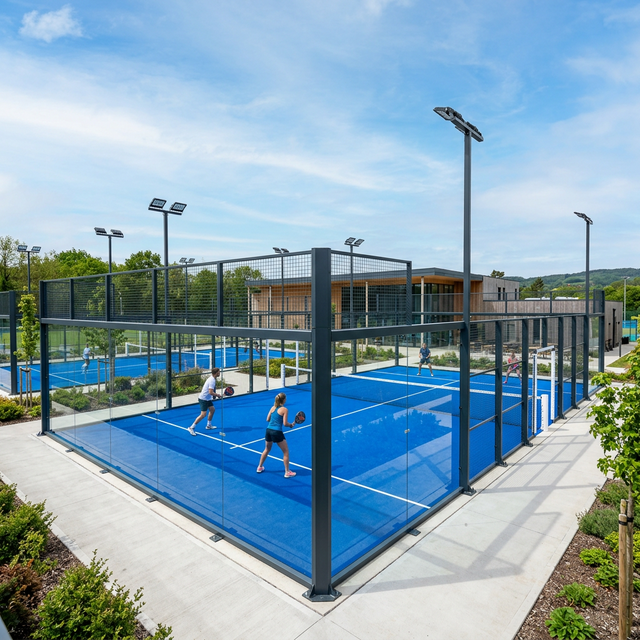
Introduction: Padel Facilities as an Investment
The UAE has witnessed a significant rise in demand for premium padel tennis facilities. Whether you are a commercial investor converting a warehouse, a property developer adding amenities, or a private owner, understanding the financial and logistical investment is critical. An accurate budget requires a thorough breakdown of the technical and structural factors that drive padel court construction costs.
What determines padel court construction cost?
The cost of constructing a padel court in the UAE depends on whether the court is built indoor or outdoor, the type of sub-base civil foundation required, structural steel specifications, glass thickness (tempered safety glass), turf grade, lighting lux requirements, and canopy shading systems.
Major Cost Components Breakdown
When planning your budget, it is important to recognize that turn-key pricing is influenced heavily by the quality of materials and the scope of site preparation. Here are the primary cost drivers:
1. Site Preparation & Civil Groundworks
Before the court structure can be installed, the sub-base must be properly prepared. This involves soil compaction, laser-guided leveling, and the casting of a reinforced concrete slab or asphalt sub-base. The existing ground conditions are a highly variable cost driver. Additionally, outdoor courts require careful project/site-design considerations for rainwater drainage.
2. Structural Steel Framework
The steel skeleton must withstand player impact and environmental conditions. For outdoor UAE installations, corrosion protection should be selected according to environmental exposure, project specifications and the intended service conditions. Proper structural engineering ensures the framing maintains its integrity against wind loads.
3. Wall Enclosure: Tempered Safety Glass & Fencing Mesh
The playing walls consist of structural glass and rigid fencing. The cost varies based on the specifications of the tempered safety glass used. Furthermore, the sports fencing and perimeter enclosures around the court utilize galvanized electro-welded metallic mesh to ensure balls stay in play and players remain safe.
4. Playing Surface: Artificial Turf
The turf directly impacts player experience and court lifespan. High-quality textured or monofilament fibrillated artificial turf, installed with properly graded kiln-dried silica sand infill, is essential for a true ball bounce and optimal foot traction. The density and quality of the turf are significant budget factors.
5. Sports LED Floodlighting
Padel is frequently played in the evening, making lighting infrastructure crucial. FIP rules specify distinct minimum lighting levels:
- Outdoor: Minimum 200 lux for local competitions, training, and recreational use. Minimum 500 lux for international and national competitions.
- Indoor: Minimum 300 lux for local/recreational use. Minimum 750 lux for international and national competitions.
Meeting these standards requires appropriate LED sports floodlights, energy-efficient drivers, and adequate electrical supply to the site.
6. Canopy & Shading Systems
For outdoor courts, installing an architectural tensile canopy is a major capital addition, but it allows for year-round play during the UAE summer months. The structural steel and UV-resistant membrane required for a canopy significantly impact the overall project budget.
Indoor vs Outdoor Padel Court Construction
The cost profile changes significantly between indoor and outdoor projects:
- Outdoor Courts: Typically require extensive civil earthworks, heavier corrosion protection for steel, weather-resistant materials, and optional shade canopies to withstand sun exposure. When planning a padel court company in Sharjah or other emirates, outdoor club complexes must account for these environmental factors.
- Indoor Courts: Warehouse conversions (such as those popular for padel court construction in Dubai industrial zones like Al Quoz or DIP) eliminate sun exposure and canopy costs. However, they require acoustic insulation and specific clear ceiling heights. FIP specifies a minimum height of 6m throughout the court, and suggests 8m minimum for new facilities to avoid ball interference.
Project Logistics & Planning
A realistic budget must also factor in the timeline. Project duration depends on site preparation, approvals, court quantity, material availability, installation conditions and the scope of associated works. Depending on the project, site and authority requirements, approvals or coordination with relevant authorities may be required.
What Information Do You Need Before Requesting a Quote?
To receive an accurate estimation, potential buyers should prepare the following details before contacting a contractor:
- Dimensions & Plot Size: Ensure you have enough space. The interior measurements (playing area) of a standard doubles court are 10m wide x 20m long. This is not the external footprint; additional space is required for the structure and walkways.
- Existing Ground Condition: Is there an existing concrete slab, or is the land undeveloped?
- Environment: Will the courts be indoor or outdoor?
- Electrical Supply: Is there sufficient power available on-site for the required lighting lux levels?
Questions to Ask a Padel Court Contractor
When evaluating bids, ask the following critical questions to avoid hidden costs:
- Is the steel corrosion protection appropriate for the specific site exposure?
- Are the glass panels tempered safety glass?
- What is the quality and density of the artificial turf system?
- Does the lighting proposal meet the appropriate FIP minimum lux requirements for indoor/outdoor use?
- Is the full turnkey installation handled in-house, including sub-base coordination?
Conclusion
Investing in padel facilities requires careful evaluation of civil works, structural materials, and engineering specifications. By understanding these cost drivers, investors can confidently plan their budgets and select the right turnkey contractor to deliver a premium, durable facility.